
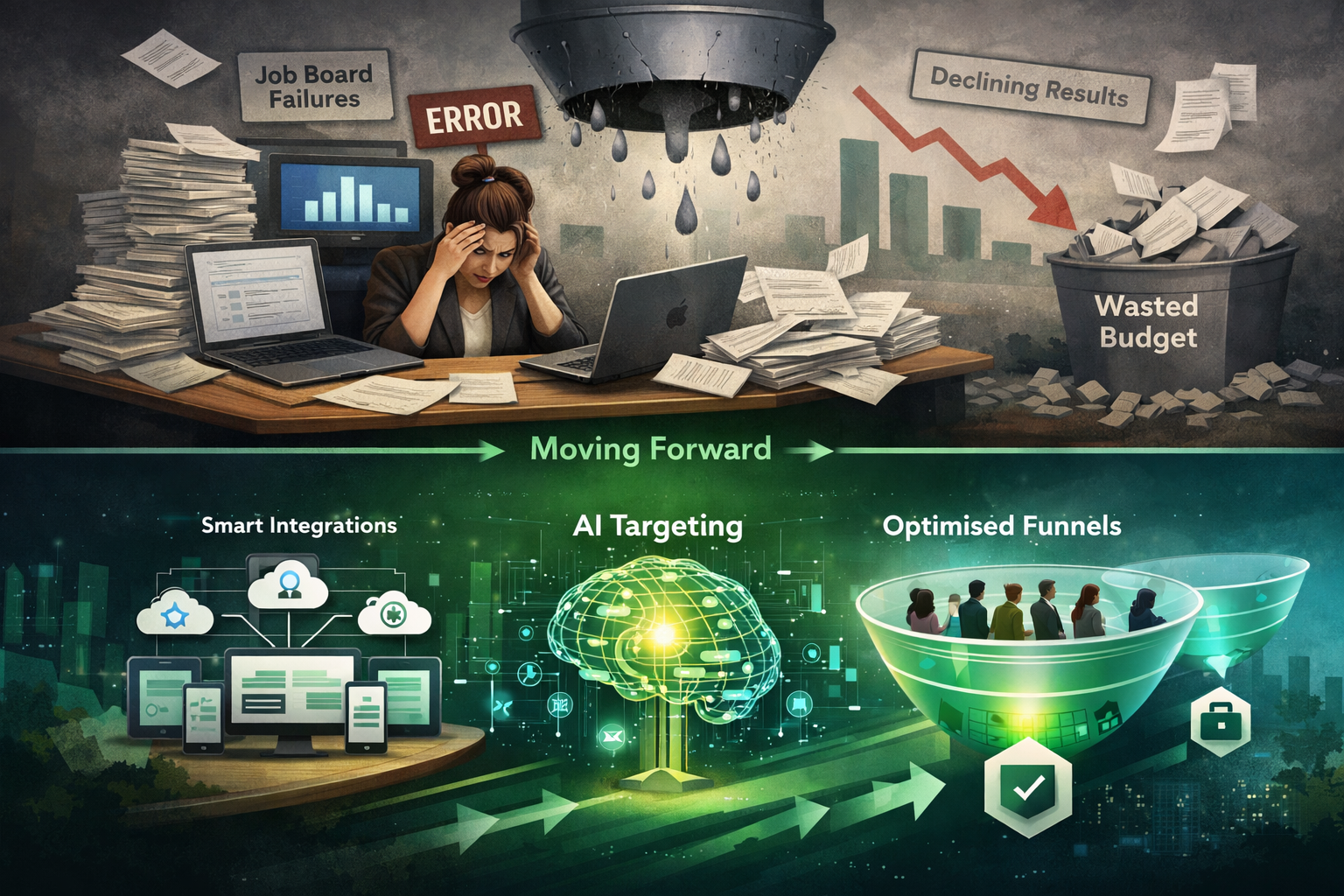
Hiring targets have not got smaller. Budgets have. And the channels most teams built their hiring plans around are harder to defend every quarter.
Job boards still have a place. But they are not a strategy.
In 2026, the teams that win use a recruitment marketing operating system. It is built to reach the right people, convert them fast, and prove what drove the hire.
If you have not read our last blog post yet, our hub article to kick off the year, start here. It sets the full context and the four-part operating system: Recruitment marketing in 2026: the operating system for hiring teams under pressure.
A job board strategy fails when you are paying for inventory, not outcomes.
The replacement is a recruitment marketing operating system: audience-first targeting across channels, a fast mobile apply journey, cross-channel retargeting, and always-on optimisation that reallocates budget to what is working.
This is how you reduce wasted spend and hire faster with better-fit applicants.
Most TA leaders are facing the same pattern. Job boards deliver volume, but quality is inconsistent. You get bursts of activity, then gaps. The team spends more time screening than hiring.
And when the CFO asks what drove the hire, the answer is usually messy. That is not a talent problem. It is a system problem. Job boards were built for a world where candidates searched and applied.
In 2026, attention sits in feeds. Candidates need context. Decisions take more than one touch.
Even large, established players have shown strain. Monster and CareerBuilder filed for Chapter 11 in June 2025. Hays issued a profit warning in June 2025. Reed data also showed a 23% drop in postings year on year in early 2025.
This is not the whole story, but it is a clear signal: The model is under pressure, and hiring teams need a different way to buy outcomes.
Job boards are good for:
Job boards struggle when:
If your plan for 2026 is still “post more roles and spend more”, you are buying more of the same outcome.
Job boards sell listings, reach, and clicks. That means your levers are limited.
You cannot properly:
So when quality drops, the usual response is to buy more inventory. That increases screening time and drags down time to hire. It also makes cost per hire harder to defend.
A recruitment marketing operating system is built for the opposite. It is designed to allocate spend to outcomes, not impressions.
The operating system has four parts. You can run it with a team, or you can run it with a partner. But the logic stays the same.
Stop paying for broad reach.
Build campaigns around the people you need, not the job title.
Target by skills, geography, behaviours, and lookalikes from success.
Use multiple channels because people behave differently on each one.
Treat the apply journey like a checkout.
If candidates cannot apply fast on mobile, your spend leaks.
Role landing pages, short first steps, and clear messages change outcomes quickly.
Candidates rarely decide on the first touch.
Retargeting keeps the best people warm and brings drop-offs back.
It also helps you build trust, which job ads alone do not.
This is the difference between activity and performance.
Test audience, creative, channel mix, and timing.
Then reallocate budget continuously to what is working.
This is where AI adds real value.
AI should not decide who gets hired. It should remove waste and increase performance through optimisation and automation.
If you want the full operating model, it is here: Recruitment marketing in 2026: the operating system for hiring teams under pressure.
You do not need a theoretical argument. You need outcomes. Here are three.
Babcock needed to hire trades and mechanics in remote locations. Skills shortages were real. Trust mattered.
With a social-first strategy built on targeting, storytelling, and remarketing, Babcock generated 32,748,350 impressions and made 571 hires, at £23.45 cost per application and £200 cost per hire.
They also saved £80,000 by reducing reliance on traditional job boards.
Read the full case study: From zero to millions: Babcock’s social media hiring revolution with Gaia.
Mitie needed to reach under-represented candidates for secure justice roles.
They also needed better downstream results, including attendance and pass rates.
Using Gaia’s AI-powered, cross-channel targeting across eight channels, Mitie hired 250+ people at £240 cost per hire, cut time to hireby 45%, and exceeded MoJ diversity targets.
Read the full Mitie case study here.
DHU needed to recruit across clinical and non-clinical roles.
They needed speed, cost control, and retention.
Using an always-on model powered by GaiaComplete, DHU cut time to start from 98.23 to 59.63 days, improved 12-month retention from 36% to 74%, and unlocked a £2.5m cost benefit calculated internally.
Read the full case study here: How DHU Healthcare cut time to start by 39 days and unlocked £2.5m in recruitment cost benefits thanks to Gaia.
You do not need a total reset. You need a controlled shift. And here is a simple plan to get your started.
Choose a role type where you feel pain, and where volume hiring makes board fatigue obvious.
If you cannot get hires, use shortlists or interviews as the proxy.
What happens after the click? Where do people drop? How long does apply take on mobile?
For example: "candidates who meet X must-have criteria and accept an interview within 7 days", if that is your goal.
And keep it consistent.
Most teams jump to new channels. The fastest win is usually conversion.
Make it mobile-first. Use one clear message.
Collect what you need to progress. Save the rest for later.
If someone starts an application and drops, you need a path to bring them back. If you want a deeper conversion framework, this guide covers the end-to-end journey: A recruitment marketing team in your pocket: the full guide.
Do not turn job boards off overnight. Run a controlled test.
Pick based on the audience, not preference.
One practice; one values-led.
No...not clicks.
Retargeting is where quality often improves.
Now you start shifting spend.
If you cannot explain what changed, then you cannot defend it.
This is how you move from “we need more budget” to “we moved budget to what works”.
When boards are under pressure, the reporting conversation matters. Avoid metrics that create false confidence.
Clicks, reach, and impressions are context. They are not outcomes.
Use measures that connect to hiring - you need to know what's happening through the funnel from stage to stage all the way to new hire starting, and even retention rates of new hires too.
If you want the full measurement framework, that is the next post in this series.
AI should be used to improve performance and reduce manual work. In recruitment marketing, that means:
AI should not be used to decide who gets hired.
That line matters.
It keeps the model compliant and it keeps trust intact.
Most reporting breaks because performance and outcomes live in different systems.
Ad platforms show activity. Your ATS shows progress.
If you cannot join those dots, spend becomes harder to defend.
Integrations are how you make recruitment marketing operational. They reduce manual reconciliation, improve governance, and help you show what drove pipeline and hires.
See how Gaia approaches integrations here.
If you are happy with job boards, keep them for what they do well. But do not confuse a channel with a system.
A system gives you control over:
That is what decision makers want in 2026.
If job boards are eating budget and not delivering quality, our AI-powered recruitment marketing platform gives you the recruitment marketing operating system. All from one place. All in one dashboard.
We plan, build, launch, and optimise campaigns across up to 11 channels. We improve conversion. We retarget drop-offs. We report outcomes you can defend.
Feel free to book a demo if you want to learn how we do it and how it could help you hit your hiring goals in 2026.
The strongest alternatives focus on outcomes, not listings. Recruitment marketing platforms that run cross-channel targeting, fast apply journeys, retargeting, and ongoing optimisation are the most effective replacement for teams under pressure.
Sometimes, yes. They can work for roles with strong local supply and clear search intent. They struggle for passive talent, multi-site hiring, and quality-driven outcomes.
Job advertising is usually about placing a role in a channel. Recruitment marketing is a system that targets the right people, converts them through a fast journey, retargets drop-offs, and optimises spend to hiring outcomes.
Common signs include rising cost per hire, falling shortlist rates, higher screening load, inconsistent pipeline, and poor attribution.
Use outcome measures such as cost per completed application, quality application rate, apply to interview conversion, time to hire, time to start, and cost per hire.
AI improves targeting, budget allocation, and optimisation. It supports creative testing and automation of reporting and follow-up journeys. It should not decide who gets hired.
Job boards are not a strategy in 2026 because they sell inventory, not outcomes. The replacement is a recruitment marketing operating system: audience-first targeting across channels, fast mobile conversion, cross-channel retargeting, and always-on optimisation that reallocates budget to what is working.
Who is Gaia best for
Gaia suits in-house recruitment teams, agencies and RPOs who want:
- To reach beyond job boards into the open web and social channels.
- Real-time campaign optimisation and data-driven decision making.
- Flexibility between self-serve and managed service.
- Seamless integration with existing ATS workflows.
- A measurable lift in quality and volume of applicants.
Adzuna works well for teams who want a large active-jobseeker search audience, now combined with social advertising and candidate automation, delivered as a managed service.
Final word: Gaia vs Adzuna
If you need broad, AI-targeted reach, multi-channel automation and real performance data, Gaia delivers a fundamentally different proposition to job board aggregators like Adzuna. Both now operate in social recruitment advertising, but Gaia is purpose-built for performance, with broader reach across the open web and paid search, real-time cross-channel optimisation, cookie-free retargeting and the choice of self-serve or managed delivery. For TA, HR and EB leaders tasked with hitting hiring targets in competitive markets, Gaia provides the tools, intelligence and flexibility to succeed.
Learn more about GaiaComplete or book a demo to see it in action.