
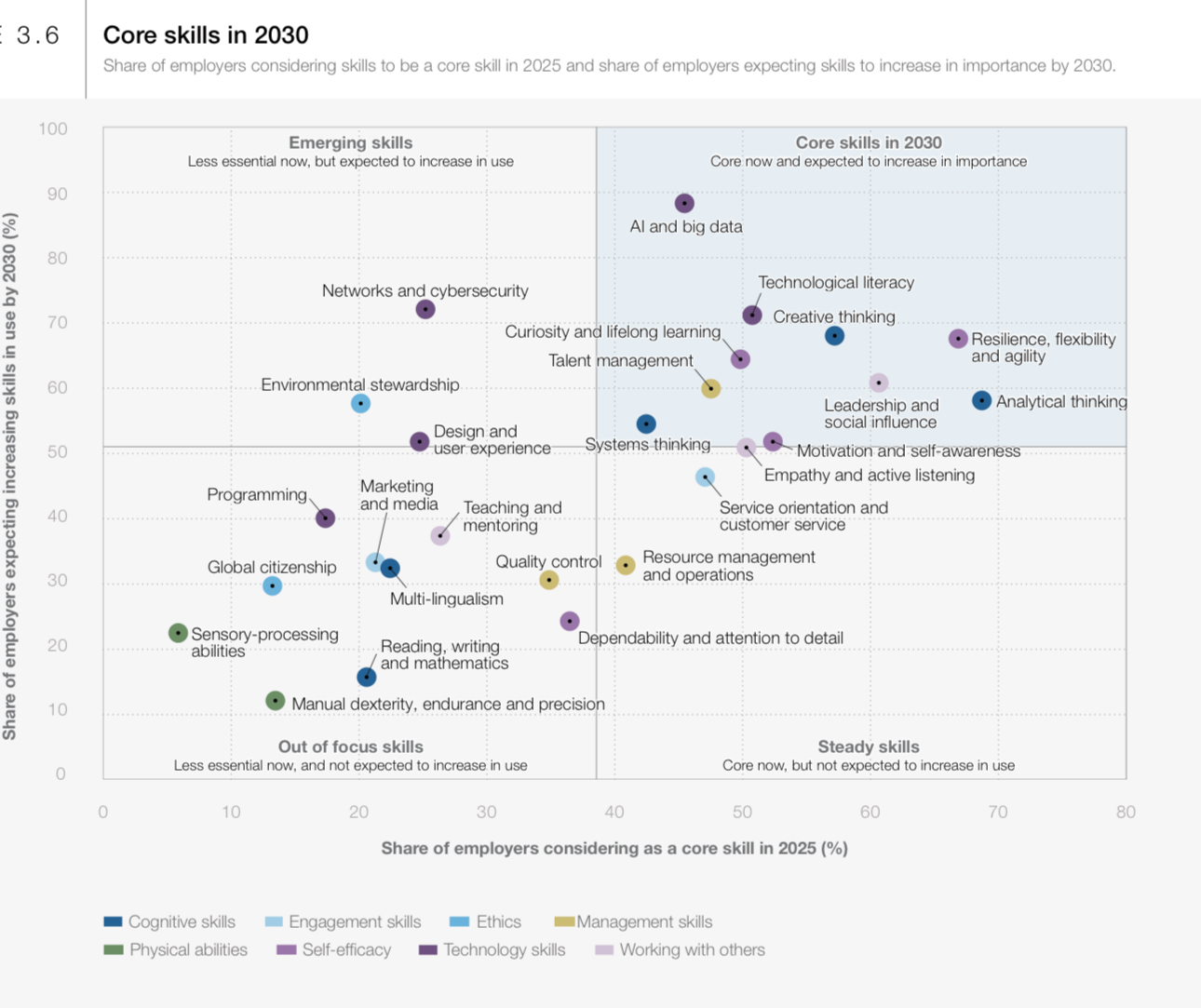
Automation, AI and human creativity are rewriting the rulebook for work. According to the World Economic Forum’s Future of Jobs 2025 report, published in January, there will be two fundamental changes: 39% of core skills will change by 2030, which will be led by growth in analytical thinking, resilience, creativity and tech literacy. Additionally, 37% of workplace tasks will be fully automated shifting focus towards human-machine collaboration.
Although the report was released at the start of this year, it remains one of the most important reference points for understanding how the world of work is evolving. It explores how technology, demographics and macroeconomic trends will shape jobs, skills and workforce strategies between 2025 and 2030.
This isn’t a story about job loss. It’s about transformation. The employers who adapt now will win later.
The report offers a roadmap for how work is evolving. And it reinforces exactly what Gaia was built to help with:navigating a world where employers must adapt fast, and where hiring intelligently matters more than ever.
The WEF forecasts a 7% net increase in global employment by 2030. That's around 78 million new jobs. Growth will come from roles in AI, big data, renewable energy, and healthcare. Jobs likely to shrink sit in administrative and manual sectors.
The key takeaway: technology won’t eliminate work. It will redefine what humans are valued for: empathy, judgement and creativity.
Nearly two out of five existing skills will change within five years. The fastest-growing are analytical thinking, resilience, adaptability, creative thinking, and technological literacy.
That means hiring can no longer rely on static job descriptions. Employers need to assess learnability, not just experience. As the report notes, skills agility is now the most valuable currency in the labour market.
For recruitment, this means shifting from keyword matching to identifying future-fit potential. And this is exactly what Gaia’s AI targeting and optimisation are designed to do.
The WEF estimates 59% of workers will need retraining by 2030, yet fewer than half of organisations have a clear plan. Those that invest early in reskilling and upskilling will build more resilient teams and stronger brands.
And that means it needs to be recognised as a productivity strategy, well beyond an HR issue. Organisations that train for adaptability perform better through disruption, and become magnets for the kind of candidates who want to grow with them.
Diverse teams adapt faster. The report highlights that inclusion and equality are now economic priorities, not just social ones. Businesses that reflect the diversity of the communities they serve are better equipped to innovate, problem-solve and attract talent.
Gaia’s cross-channel campaigns already help employers reach candidates traditional job boards miss. Whether that's underrepresented graduates or skilled workers in new regions, it’s inclusive by design: technology helping humans reach other humans.
By 2030, 37% of all workplace tasks will be automated, but that doesn’t mean humans step aside. It means humans and machines collaborate.
Our co-founder and architect of our AI-powered platform, Ben Keighley, calls this approach “humans-in-the-loop”. It captures the essence of the next decade: AI doing the heavy lifting, people doing the thinking, connecting and creating. Gaia’s evolution follows the same principle: intelligent automation that amplifies human capability.
Every company is facing the same question: how do we build teams ready for the future?
Here’s a practical checklist for 2026 planning:
The Future of Jobs 2025 report is more than research. It’s a mirror held up to every business. It shows how fast the skills landscape is shifting and why employers must move now.
At Gaia, we’re building for that future.We help employers attract and convert the adaptable, creative, tech-literate talent that will shape the next decade.
The future of work isn’t coming. It’s already hiring.
Who is Gaia best for
Gaia suits in-house recruitment teams, agencies and RPOs who want:
- To reach beyond job boards into the open web and social channels.
- Real-time campaign optimisation and data-driven decision making.
- Flexibility between self-serve and managed service.
- Seamless integration with existing ATS workflows.
- A measurable lift in quality and volume of applicants.
Adzuna works well for teams who want a large active-jobseeker search audience, now combined with social advertising and candidate automation, delivered as a managed service.
Final word: Gaia vs Adzuna
If you need broad, AI-targeted reach, multi-channel automation and real performance data, Gaia delivers a fundamentally different proposition to job board aggregators like Adzuna. Both now operate in social recruitment advertising, but Gaia is purpose-built for performance, with broader reach across the open web and paid search, real-time cross-channel optimisation, cookie-free retargeting and the choice of self-serve or managed delivery. For TA, HR and EB leaders tasked with hitting hiring targets in competitive markets, Gaia provides the tools, intelligence and flexibility to succeed.
Learn more about GaiaComplete or book a demo to see it in action.