
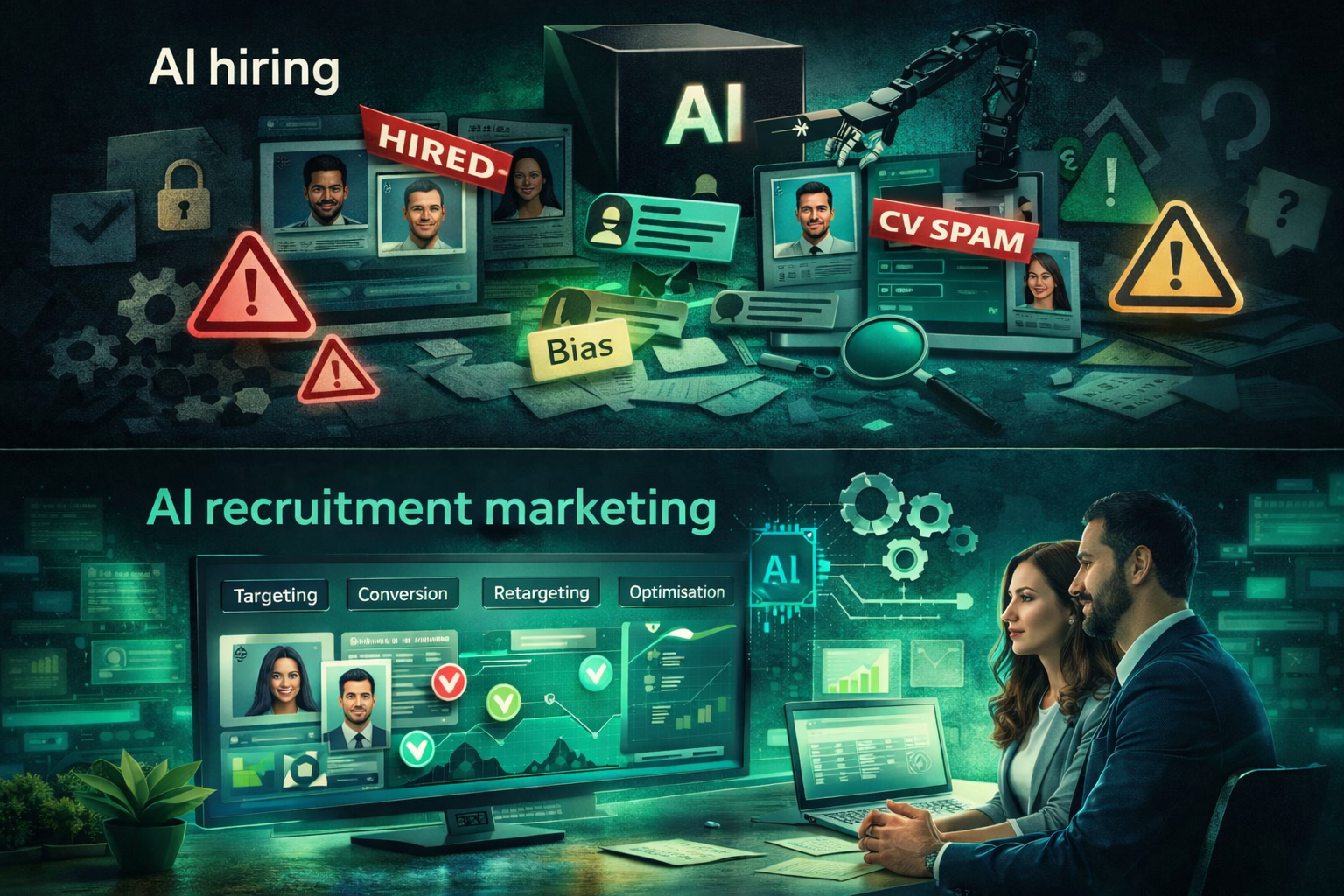
AI is everywhere in hiring right now.
Some of it is useful. Some of it is dangerous. A lot of it is vague.
Most hiring leaders are being asked the same three questions by their teams, their legal function, and their CFO.
Is it safe?
Is it biased?
Does it work?
This post gives a plain-English view of AI recruitment marketing. What it should do, what it must not do, and how to evaluate vendors without getting pulled into hype.
If you have not read our hub piece yet, start there. It sets the tone for the year: Recruitment marketing in 2026: the operating system for hiring teams under pressure.
If you’re still relying on job boards and seeing quality drop or costs climb, read Post 1 in this series. It explains why job boards are not a strategy in 2026, and what to run instead: Job boards are not a strategy in 2026. Here’s the replacement.
AI recruitment marketing is the use of AI to improve performance tasks in hiring campaigns, such as targeting, budget reallocation, creative testing, landing page optimisation, and automation.
It should not decide who gets hired.
Used well, AI reduces wasted spend and increases the flow of better-fit applicants by optimising the system around outcomes.
Most hiring teams are not short of effort. They are short of time and control. The work that eats time is predictable:
This is not strategic work. It is operational work. It is also the work that drives performance if it is done well.
AI should solve this by doing two things.
First, it should automate the repetitive tasks that steal time.
Second, it should optimise the system continuously, so money moves to what is actually working.
That is what hiring teams need in 2026. A recruitment marketing operating system that runs like a performance engine, without adding headcount.
AI recruitment marketing is the use of AI to improve how you identify, attract and convert candidates through digital channels. It analyses performance signals and helps you make better decisions on:
If AI is not improving one of those outcomes, it is not doing recruitment marketing. It is doing theatre.
When buyers ask “does it work?”, they usually mean “what changes in the system?”. Here are the mechanisms that matter, and why.
Pain
Most teams optimise in bursts.
Someone checks performance weekly, tweaks settings, and hopes.
But candidates do not behave weekly. Platforms do not change weekly. Competition does not change weekly.
Solution
AI can optimise continuously.
It can learn which audience and creative combinations are producing quality applications, then adjust spend and delivery in smaller increments.
Outcome
Less wasted spend and faster learning.
This matters most when you are under pressure and cannot afford slow feedback loops.
Pain
Job boards are broad by design.
Even when they offer targeting options, you are usually operating inside limited levers.
Solution
AI can help build and refine audiences based on performance signals.
That includes behaviour patterns, engagement, and what has converted in the past.
It can also help build lookalikes from known success, which is often a quicker route to quality.
Outcome
You stop paying for noise.
You see fewer irrelevant applicants and more candidates who match what hiring managers actually want.
Proof in the wild: Mitie needed to reach under represented candidates for secure justice roles and improve downstream outcomes like attendance and pass rates.
Using Gaia’s AI-powered, cross-channel targeting across eight channels, Mitie hired 250+ people at £240 cost per hire, cut time to hire by 45%, and exceeded MoJ diversity targets. (Read the full case study: Mitie.)
Pain
Most teams set budgets and then live with the consequences.
If a channel underperforms, money still flows there until someone notices.
Solution
AI can reallocate budget dynamically across channels, audiences, and creative.
That means spend moves toward the combinations that are driving outcomes.
Outcome
Performance improves without the team needing to do manual firefighting.
This is the difference between running campaigns and running a system.
Pain
Most teams do not test.
They reuse the same job ad creative because they do not have time to create new variants, and they are nervous about employer brand risk.
Solution
AI makes testing practical.
It helps identify patterns in what is resonating. It supports rapid iteration, and it helps decide which variant to show to which audience.
Humans still decide what the brand stands for.
AI helps remove guesswork in what drives action.
Outcome
Higher conversion and better candidate fit, because the message is clearer and more relevant.
Pain
Clicks are easy to buy.
Completed applications are not.
Apply journeys often leak spend through friction, especially on mobile.
Solution
AI can support landing page optimisation by spotting drop-off points and patterns.
It can inform what to simplify, what to clarify, and what to move earlier or later.
Outcome
More completed applications from the same spend.
This is often the fastest win when teams are under pressure.
If you want the full journey framework, this guide covers it end to end: A recruitment marketing team in your pocket: the full guide.
Pain
Hiring teams do not have time to do the same work every week.
Campaign builds, reporting, and follow-upare often manual.
Solution
AI helps automate the repetitive parts.
That includes reporting outputs, retargeting sequences, and operational steps that keep activity live.
Outcome
You get more consistency and fewer gaps.
This is what always-on looks like when you do not have a large team.
This is the most important section for HR Ops and Compliance. AI should not decide who gets hired. And that includes:
If a vendor is selling “AI that chooses the best candidates”, treat it as a risk. AI in recruitment marketing is different. It sits before selection. It improves who you reach and how you convert them. You still decide who progresses.
This separation matters because it reduces legal and ethical risk and keeps trust intact.
AI recruitment marketing can create bias if it is trained or optimised against the wrong outcomes, or if it uses data that embeds historic inequality.
But it can also support fairer outcomes if it is used to widen reach, reduce reliance on narrow channels, and measure performance across different audiences.
Here is a safe way to think about it.
Bias risk increases when:
Bias risk reduces when:
If you are serious about this, your vendor should be able to explain:
Most AI marketing language is designed to sound impressive. But it rarely explains what the system is doing. Use this framework to cut through it.
Good answers sound like:
Risky answers sound like:
If the vendor cannot answer in plain English, pause.
If the goal is clicks, the outcome will be cheap clicks.
If the goal is completed applications and quality proxies, the system can optimise toward hiring reality.
Ask for the exact optimisation targets.
You want to see:
If they only show top-of-funnel metrics, they are selling activity.
AI can move fast. That is why governance matters.
Ask:
If the answer is “the system just learns”, that is not governance.
If you are buying AI recruitment marketing in 2026, ask these questions.
Data
Measurement
Governance
This is where integrations matter. If performance lives in ad platforms and outcomes live in your ATS, you need a bridge.
And that bridge is integrations.
A lot of AI risk is not “AI”.
It is the absence of traceability.
If you cannot see what drove the hire, you cannot defend the spend.
If you cannot connect campaign activity to candidate progress, you cannot govern the system.
Integrations close the gap between marketing activity and hiring outcomes.
They also reduce manual reconciliation, which is where reporting and compliance errors often creep in.
If you want to see how we at Gaia approach this, start here: Integrations.
Use this as a quick vendor screen.
If you see more than two of these, treat it as a risk.
Use this checklist in procurement and stakeholder reviews.
Performance
Safety
Governance
Measurement
Imagine you are hiring for secure justice roles.
You need reach. You need diversity outcomes. You need hires quickly.
You launch multi-channel campaigns targeted at the right audience groups.
The system tracks not only clicks, but completed applications and quality proxies.
AI reallocates budget away from low-quality sources and towards the audiences and channels converting.
Creative variants are tested and refined, with human approval.
Retargeting brings back drop-offs with follow-up messages.
Reporting connects activity to outcomes, so spend is defensible.
That is AI doing performance work, not hiring work.
If you want AI recruitment marketing that improves outcomes without increasing risk, GaiaComplete gives you the recruitment marketing operating system.
We use AI to optimise targeting, budget allocation, creative testing, and campaign performance across up to 11 channels. We improve conversion. We retarget drop-offs. We report outcomes you can defend…find out how on a demo.
AI recruitment marketing uses AI to improve performance tasks in hiring campaigns, such as targeting, budget reallocation, creative testing, landing page optimisation, and automation. It should not decide who gets hired.
It can be, if it is used for marketing performance rather than hiring decisions, and if governance controls and monitoring are in place. Vendors should be able to explain what data is used, what is optimised, and what guardrails exist.
Bias risk exists if AI optimises for the wrong outcomes or relies on narrow proxies. You reduce risk by optimising to hiring-relevant outcomes, widening reach across channels, monitoring performance appropriately, and keeping human oversight.
Ask what decisions the AI makes, what it optimises for, what data it uses, how it proves impact, and what governance controls exist. Also ask how it connects campaign activity to ATS outcomes.
Integrations connect marketing activity to hiring outcomes in the ATS or HR systems. This improves attribution, reduces manual reporting, and makes governance and ROI defensible.
AI recruitment marketing uses AI to optimise recruitment campaigns through better targeting, budget reallocation, creative testing support, landing page improvement, and automation. It should not be used to make hiring decisions. The value is reduced wasted spend and a higher flow of better-fit applicants, with reporting that can be governed.
Who is Gaia best for
Gaia suits in-house recruitment teams, agencies and RPOs who want:
- To reach beyond job boards into the open web and social channels.
- Real-time campaign optimisation and data-driven decision making.
- Flexibility between self-serve and managed service.
- Seamless integration with existing ATS workflows.
- A measurable lift in quality and volume of applicants.
Adzuna works well for teams who want a large active-jobseeker search audience, now combined with social advertising and candidate automation, delivered as a managed service.
Final word: Gaia vs Adzuna
If you need broad, AI-targeted reach, multi-channel automation and real performance data, Gaia delivers a fundamentally different proposition to job board aggregators like Adzuna. Both now operate in social recruitment advertising, but Gaia is purpose-built for performance, with broader reach across the open web and paid search, real-time cross-channel optimisation, cookie-free retargeting and the choice of self-serve or managed delivery. For TA, HR and EB leaders tasked with hitting hiring targets in competitive markets, Gaia provides the tools, intelligence and flexibility to succeed.
Learn more about GaiaComplete or book a demo to see it in action.