
Most hiring problems do not start with a shortage of applications.
They start with the wrong applications.
That is why job board spend can look busy while teams still fail to shortlist. You get volume, but it does not turn into interviews, offers, and starts.
Recruitment marketing targeting fixes this. It shifts you from buying broad inventory to reaching the people who are likely to fit, apply, and progress.
This is Post 3 in our 2026 recruitment marketing series. If you have not read the hub piece, start there: Recruitment marketing in 2026: the operating system for hiring teams under pressure.
If you are still leaning heavily on job boards, read Post 1 next. It explains why job boards are not a strategy in 2026, and what’s replacing them.
And if you are weighing up AI, risk, and governance, then Post 2 sets the guardrails: AI recruitment marketing explained: what it does, what it doesn’t, and why it matters.
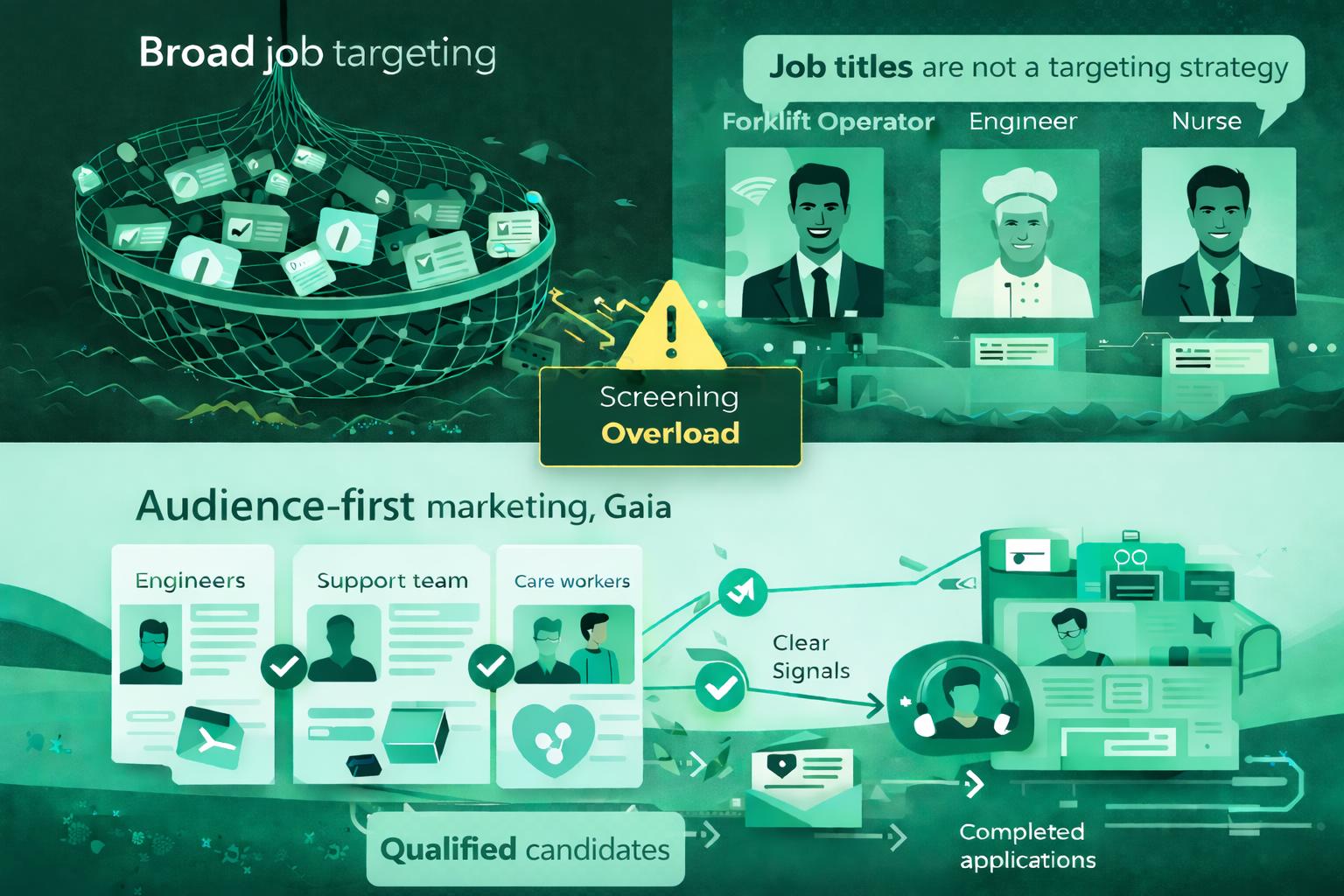
Recruitment marketing targeting means building campaigns around the audience you need, not the job title.
It uses signals like skills, location, behaviours, and lookalikes, then tests across channels to find where the right candidates actually convert.
Done well, targeting reduces irrelevant applications, increases quality, and makes hiring faster without increasing spend.
Hiring teams are under pressure to do two things that often conflict:
When teams rely on broad channels, they usually have to trade one for the other. They buy volume and accept a lower fit rate, and then try to fix it in screening.
But screening is not free. It burns recruiter time, slows down candidates who are actually good fits, and increases drop-off at the worst possible stage.
Targeting fixes the problem upstream. If you can reach people who are more likely to fit the role, you reduce screening load and shorten time to shortlist.
That is why targeting is the first move in the recruitment marketing operating system.
Job title targeting is the default because it is easy. It is also unreliable. Here is why.
A “support worker” can mean different things across employers.
A “service engineer” can span three skill levels.
Job boards and platforms often group these roles together, which inflates reach and reduces relevance.
People use different words for the same role.
They search for location, shift pattern, salary, or training, not a job title.
High quality candidates are often not searching.
They might be open to a move, but they are not browsing listings.
If your targeting relies on search behaviour, you never reach them.
Broad job titles attract broad applications. That creates noise.
And once noise enters the funnel, it costs you time and quality.
Recruitment marketing targeting solves this by starting with the audience, then building the message and channel mix around how they behave.
If you want targeting to produce quality, you need to stop thinking in one audience.
Most campaigns work better when they are built around audience types, each with its own message and channel mix.
Here are five that consistently matter.
These candidates are looking now.
They respond to clear role details, location, salary, and speed.
They convert fast if the apply journey is simple.
These candidates are not searching, but they will move for the right reasons.
They need context.
They respond to role benefits, shift patterns, development, and team culture.
They often convert after multiple touches.
These candidates are changing sector, returning to work, or moving from adjacent roles.
They respond to training, support, and clarity on what is transferable.
These candidates are defined by geography and convenience.
For multi-site hiring, this is where you win.
The message is often about commute time, shift stability, and predictable hours.
These audiences are built from what worked in the past.
If you have a reliable definition of quality, you can build lookalikes that widen reach without losing fit.
This is where AI targeting can be powerful, provided it is governed properly and optimised to outcomes, not clicks.
If you want the practical end-to-end framework for running this, then check this out: A recruitment marketing team in your pocket: the full guide.
This is a practical method you can use without a large marketing team.
If you do not define quality, targeting will drift. So keep it simple.
Examples:
Choose one definition you can measure.
Do not start with everything. Start with one role family where you feel pain and where improvement will be noticed.
Frontline hiring is often the fastest route to proof, because targeting and conversion issues show up clearly.
Write three simple hypotheses. For example:
Each hypothesis becomes a targeting and creative test.
Choose channels based on how your audience behaves, not what you are used to. A simple starting point:
Your best mix depends on the role family. The goal is not “be everywhere”. The goal is “be where the right candidates actually convert”.
Targeting is only useful if you can measure outcomes. At minimum, you need to track:
If you cannot break it down, you cannot learn.
This is where integrations matter, because the more you can connect activity to progress in your ATS, the more defensible your targeting becomes.
A common mistake is to treat channels like strategy.
Channels are distribution.
Your strategy is the audience and the journey.
Here is a practical way to think about it.
Start with channels that deliver reach and conversion, then retarget.
That usually means Meta and TikTok, with a simple mobile-first apply journey.
Use channels that allow storytelling and repetition.
That usually means YouTube for trust, plus retargeting across Meta or LinkedIn.
Focus on geography-first targeting and convenience messaging.
Then use retargeting to bring back drop-offs.
Widen reach beyond a single channel.
Use audience groups and measure outcomes by group.
Avoid optimising only for cheapest clicks.
If diversity is a focus for you, this is a useful companion piece: Diversity hiring shouldn’t be guesswork.
Targeting does not need to be a quarterly project. It should be a weekly routine.
Here is a simple rhythm to help you get started.
This routine keeps targeting honest. It also gives you a defensible story: what you tested, what you learned, what you changed.
Targeting is where you can see the difference between activity and outcomes.
Mitie needed to reach underrepresented candidates for secure justice roles. They also needed stronger downstream results, including attendance and pass rates.
Using Gaia’s AI-powered, cross-channel targeting across eight channels, Mitie hired 250+ people at £240 cost per hire, cut time to hire by 45%, and exceeded MoJ diversity targets. Read the full case study, here: Mitie.
These are the patterns we see most often.
Clicks are cheap. Quality is not.
If you optimise to clicks, you will get clicks.
Instead, optimise to completed applications and quality proxies.
Most roles need at least two audiences and two messages.
One for active seekers.
One for passive but persuadable.
If you only rely on one channel, you inherit its limits.
Multi-channel targeting reduces risk and improves learning.
Targeting cannot save a broken apply journey.
If the page is slow, the form is long, or mobile is painful, your spend will leak.
(Don't worry, "Conversion" is the focus for the next post in the series.
Targeting needs guardrails.
You should be able to explain what audiences you targeted, why, and what the outcome was.
If AI is involved, you need governance and traceability.
Post 2 sets the guardrails in plain English: AI recruitment marketing explained: what it does, what it doesn’t, and why it matters.
If you need targeting that reduces noise and increases quality, GaiaComplete gives you the recruitment marketing operating system. We plan, build, launch, and optimise campaigns across up to 11 social media channels. We use AI to improve targeting, budget allocation, and performance, with governance and reporting you can defend. Want to learn more? Book a demo and see how it could help improve your recruitment marketing ROI!
Recruitment marketing targeting is the process of reaching the right candidates through audience-first campaigns across digital channels. This is done by using signals like skills, geography, behaviours, and lookalikes, then optimising to hiring outcomes.
Job titles are inconsistent and candidates search indifferent ways. Job title targeting also misses passive talent. Audience-first targeting reaches people based on behaviours and fit signals, not just job title keywords.
Track completed applications, quality proxy rates, and cost per completed application by audience group. Where possible, connect targeting to downstream stages through your ATS so you can see which audiences produce interviews, offers, and starts.
The best channels depend on the role family and audience behaviour. Most teams start with Meta and one additional channel, then expand based on which audiences convert and progress. But choosing which specific channels all depends on the role and audience before choosing which channels will be most effective.
AI supports audience refinement and optimisation. It helps identify which audiences and creative combinations produce outcomes, then reallocates budget accordingly. It should not be used to make hiring decisions.
Recruitment marketing targeting helps hiring teams reach the right candidates without paying for noise. It uses audience-first targeting across channels, measures completed applications and quality proxies, and optimises spend towards the audiences that produce interviews and hires.
Who is Gaia best for
Gaia suits in-house recruitment teams, agencies and RPOs who want:
- To reach beyond job boards into the open web and social channels.
- Real-time campaign optimisation and data-driven decision making.
- Flexibility between self-serve and managed service.
- Seamless integration with existing ATS workflows.
- A measurable lift in quality and volume of applicants.
Adzuna works well for teams who want a large active-jobseeker search audience, now combined with social advertising and candidate automation, delivered as a managed service.
Final word: Gaia vs Adzuna
If you need broad, AI-targeted reach, multi-channel automation and real performance data, Gaia delivers a fundamentally different proposition to job board aggregators like Adzuna. Both now operate in social recruitment advertising, but Gaia is purpose-built for performance, with broader reach across the open web and paid search, real-time cross-channel optimisation, cookie-free retargeting and the choice of self-serve or managed delivery. For TA, HR and EB leaders tasked with hitting hiring targets in competitive markets, Gaia provides the tools, intelligence and flexibility to succeed.
Learn more about GaiaComplete or book a demo to see it in action.