
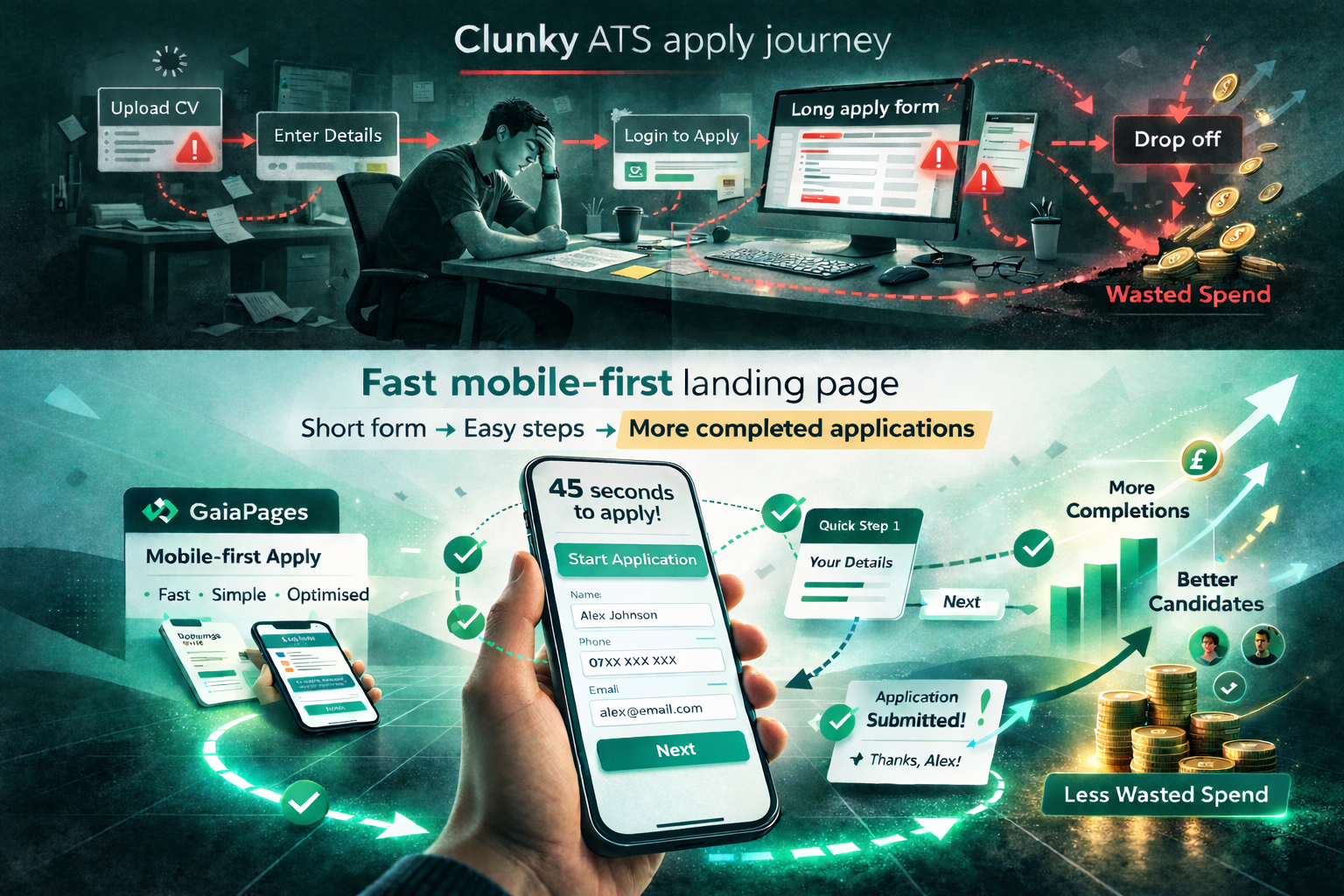
Most recruitment marketing spend does not fail in the ad account, right? It fails after the click.
Candidates tap, land on a slow page, get pushed into an ATS portal, and drop.
You pay for attention, then lose it.
This post is Post 4 in our 2026 recruitment marketing series. It is the conversion chapter.
If you want the full operating system first, start with the hub: Recruitment marketing in 2026: the operating system for hiring teams under pressure
And why not catch up on the earlier posts if you missed them.
Post 1: Job boards are not a strategy in 2026. Here’s the replacement.
Post 2: AI recruitment marketing explained: what it does, what it doesn’t, and why it matters
Post 3: Recruitment marketing targeting: how to reach the right candidates without paying for noise
If you want to improve job application conversion rate in 2026, stop treating apply as a form and start treating it as a journey.
The conversion playbook is simple: remove mobile friction, shorten the first step, keep candidates on your page, and bring drop-offs back with follow-up.
You will get more completed applications and more qualified candidates from the same spend.
Targeting gets you in front of the right people.
Conversion determines whether you keep them.
Most teams have the same hidden pattern.
Spend rises.
Clicks rise.
Applications stay flat.
Or worse, they rise but quality drops, because the only people willing to fight through the process are not the ones you want.
If you fix conversion, two things happen.
First, you get more applications from the same budget.
Second, you reduce screening overload because you can be more selective in targeting and messaging without starving the funnel.
That is why conversion is a core part of the recruitment marketing operating system.
Most drop-off sits in three places.
1) The handoff to the ATS
Candidates click an ad and expect a fast mobile experience.
Instead they hit redirects, logins, and long forms.
Every extra step is a leak.
2) Mobile friction
Most candidates apply on mobile.
But many career pages still behave like desktop forms.
Text is small. Buttons are fiddly. Upload steps are painful.
If it takes more than a minute to work out what to do, candidates leave.
3) Unclear value
A candidate does not drop because they are lazy.
They drop because the trade-off feels wrong.
They are being asked for effort without enough clarity.
This is where messaging, proof, and specificity matter.
If you want a dedicated deep dive on apply drop-off, this post covers the funnel leak in detail: The silent killer in hiring funnels: apply page drop-off
Most teams use “mobile-first” as a design label. In recruitment, it has a performance meaning.
Mobile-first apply means:
It also means the page loads quickly.
Candidate patience is lower than you think, especially in frontline and high-volume roles.
If you want a second lens on why this matters, keep this in your reading list: The hidden cost of bad candidate experience, and how to fix it
If your current apply journey lives inside an ATS portal, GaiaPages is the quickest way to create fast, mobile-first, on-brand apply pages that reduces drop-off.
GaiaPages are fast, mobile-first apply pages designed to reduce drop-off.
They're on-brand as standard and sit between your campaigns and your ATS.
Candidates get a clean experience that matches what they clicked, with a short first step that keeps momentum. And when we say "short", we mean 45 seconds to apply. Yes...45 seconds.
Your team still controls the process and the system of record stays in your ATS.
In practice, GaiaPages helps you:
This is the decision most teams get wrong.
They send every candidate into the ATS and hope the ATS converts.
That is rarely a good bet.
Use ATS apply when:
Use a landing page first when:
A landing page lets you do three high-impact things.
First, it keeps the candidate in a fast, controlled experience.
Second, it frames the value, so candidates feel the trade-off.
Third, it lets you make the first step short, then collect more detail later.
If you want a direct route to this, GaiaPages gives you fast, mobile-first apply pages designed to reduce drop-off.
This is also where you can connect recruitment marketing to hiring outcomes with fewer gaps, especially when you have the right tracking and integrations.
Here is a practical framework you can use, even if you do not have a big team.
Do not ask for everything up front. Typically, candidates seeing your ad won't have time there and then to do a full application.
Simply ask for what you need to progress. That might be:
Save CV upload and long histories for later, when the candidate is invested.
If you are worried about quality, use smart qualifying questions.
Do not use long forms as a filter. Why? They filter out good candidates too.
Candidates have little time and they also decide quickly, so they only want the basic need-to-know stuff:
If these are missing, candidates assume the worst.
Job ads alone are not trusted. Their purpose is to get attention from the right eyeballs. Pages convert when they show proof. Use:
If the role is regulated or sensitive, be honest about checks.
Let’s be honest: surprises kill conversion.
Use a simple structure:
Long paragraphs do not convert.
Most candidates do not convert on the first touch. They need a second chance. Set up:
Retargeting is the next chapter in the series, but you can start using it immediately. It is one of the fastest ways to recover wasted spend.
If you want to improve job application conversion rates, track conversion where it matters. Start with:
Then add a quality proxy, so you do not optimise for volume.
If you want a cost lens on this, this post connects budget decisions to performance: How to reduce recruitment marketing costs without losing performance
A candidate taps a job ad at 19:30 on their phone.
They get sent to an ATS portal.
The page loads slowly.
They are asked to create an account.
They need to find a CV file on their phone.
At best, they get distracted. Typically, they get frustrated.
They leave.
You pay for the click.
The candidate never returns.
Now imagine the fixed version.
Same ad.
They land on a fast page.
They see pay, shifts, location, and start speed immediately.
They apply in under a minute.
If they drop, they get a follow-up reminder automatically.
That is the difference between “we spent money” and “we hired people”.
Conversion improvements do not just lift top-of-funnel volume.
They shorten time to start.
That is the metric leaders care about.
As an example, DHU Healthcare needed speed, cost control, and retention. Using an always-on model powered by GaiaComplete, DHU cut time to start from 98.23 to 59.63 days, improved 12-month retention from 36% to 74%, and unlocked a £2.5m cost benefit (calculated internally).
Read more about this here: How DHU Healthcare cut time to start by 39 days and unlocked £2.5m in recruitment cost benefits thanks to Gaia
Let's get straight to the point:
Most ATS pages are not built for conversion.
Treat them as systems of record, not growth funnels.
Long forms create drop-off.
Short first steps create momentum.
If the essentials are missing, candidates assume the worst.
If you optimise to clicks, you will buy cheap clicks.
Optimise to completed applications and quality proxies.
Post 2 explains how to use AI safely for this type of optimisation: AI recruitment marketing explained: what it does, what it doesn’t, and why it matters
Use this checklist to improve conversion this week:
If you are paying for clicks and losing candidates after the click, GaiaComplete helps you fix the system. We run audience-first campaigns across up to 11 channels, build fast mobile-first landing pages via GaiaPages, reduce apply drop-off, and optimise performance in real time so you get more qualified candidates and fewer irrelevant applications. Sounds good, right? Why not book a demo and see how we can help you get real, measurable recruitment marketing performance impact.
A good conversion rate depends on role type and channel, but the goal is always the same: reduce friction, increase completed applications, and protect quality. If you are driving clicks and seeing drop-off in the apply journey, conversion is your highest leverage fix.
Start by removing mobile friction and shortening the first step. Avoid redirects, long forms, and account creation. Use a landing page to keep candidates in a fast journey, and add follow-up to bring drop-offs back.
Not always. Landing pages are most valuable when you are paying for traffic, hiring at volume, or seeing drop-off in the ATS journey. If your ATS apply is genuinely mobile-friendly and short, it may be enough.
Retargeting brings candidates back after they visit a page or start an application but do not finish. It recovers wasted spend and often improves quality because the second touch builds trust and clarity.
AI supports optimisation and automation. It can help test what messages, audiences, and journeys drive completed applications, then reallocate budget to what is working. It should not be used to make hiring decisions.
To improve job application conversion rate, reduce mobile friction, shorten the first step, keep candidates on a fast-landing page, and bring drop-offs back with follow-up and retargeting. Measure completed applications and quality proxies, not clicks.
Who is Gaia best for
Gaia suits in-house recruitment teams, agencies and RPOs who want:
- To reach beyond job boards into the open web and social channels.
- Real-time campaign optimisation and data-driven decision making.
- Flexibility between self-serve and managed service.
- Seamless integration with existing ATS workflows.
- A measurable lift in quality and volume of applicants.
Adzuna works well for teams who want a large active-jobseeker search audience, now combined with social advertising and candidate automation, delivered as a managed service.
Final word: Gaia vs Adzuna
If you need broad, AI-targeted reach, multi-channel automation and real performance data, Gaia delivers a fundamentally different proposition to job board aggregators like Adzuna. Both now operate in social recruitment advertising, but Gaia is purpose-built for performance, with broader reach across the open web and paid search, real-time cross-channel optimisation, cookie-free retargeting and the choice of self-serve or managed delivery. For TA, HR and EB leaders tasked with hitting hiring targets in competitive markets, Gaia provides the tools, intelligence and flexibility to succeed.
Learn more about GaiaComplete or book a demo to see it in action.