
Hiring teams ended 2025 in a squeeze. Budgets stayed tight, vacancy pressure stayed high, and the old playbook kept underperforming.
A simple shift kept working. Treat recruitment marketing like performance marketing, then use AI to do the heavy-lifting. Target the right people, retarget high intent audiences, and optimise spend daily based on what converts.
This is our 2025 wrap, plus a short snapshot of what to prepare for in 2026. We'll cover that in our end of year blog post to help us all be ready for whatever the next 12 months throws at us!
Recruitment budgets came under scrutiny across sectors, and leaders asked harder questions about cost per hire and ROI. The CIPD’s 2024 resourcing and talent planning research set the tone for 2025 by tracking the ongoing pressure on recruitment budgets and cost per hire.
When budgets are tight, “more applicants” stops being a win. Hiring teams need better fit applicants, plus proof they can take to Finance.
Recruitment marketing in 2025 meant “job discovery” replaced “job search”. Candidates did not stop wanting jobs. They stopped looking in the same places.
We saw a clear shift away from “search then apply” towards “see, feel, trust, then apply”. Social content, peer proof, and employer brand signals played a bigger role earlier in the journey. Brands needed to be less transactional, and more real…more human.
This matters because attention is where your candidates are. Data Reportal’s Digital 2025 report puts UK social media users at 54.8 million, 79% of the population.
If your recruitment marketing still starts and ends with a job post, you are competing in the smallest part of the market.
And this is why we’re passionate about putting recruitment marketing in the pocket of every business.
Job boards struggled as brands realised that the firehose approach was burning budget and time, triggering a tsunami of “me too” CVs that didn’t fit the role. The result? Some of the biggest names struggled and it became big news in the recruitment industry.
CareerBuilder + Monster filed for Chapter 11 bankruptcy protection in June 2025. Reuters reported the filing and the company’s plan to sell major business units.
That same month, recruiter Hays issued a profit warning, pointing to weaker confidence and a broader hiring slowdown.
None of this means “job boards are dead”. It means they are increasingly the wrong starting point for growth hiring, especially when you need volume and quality at once. Not to mention specialist, hard-to-fill roles.
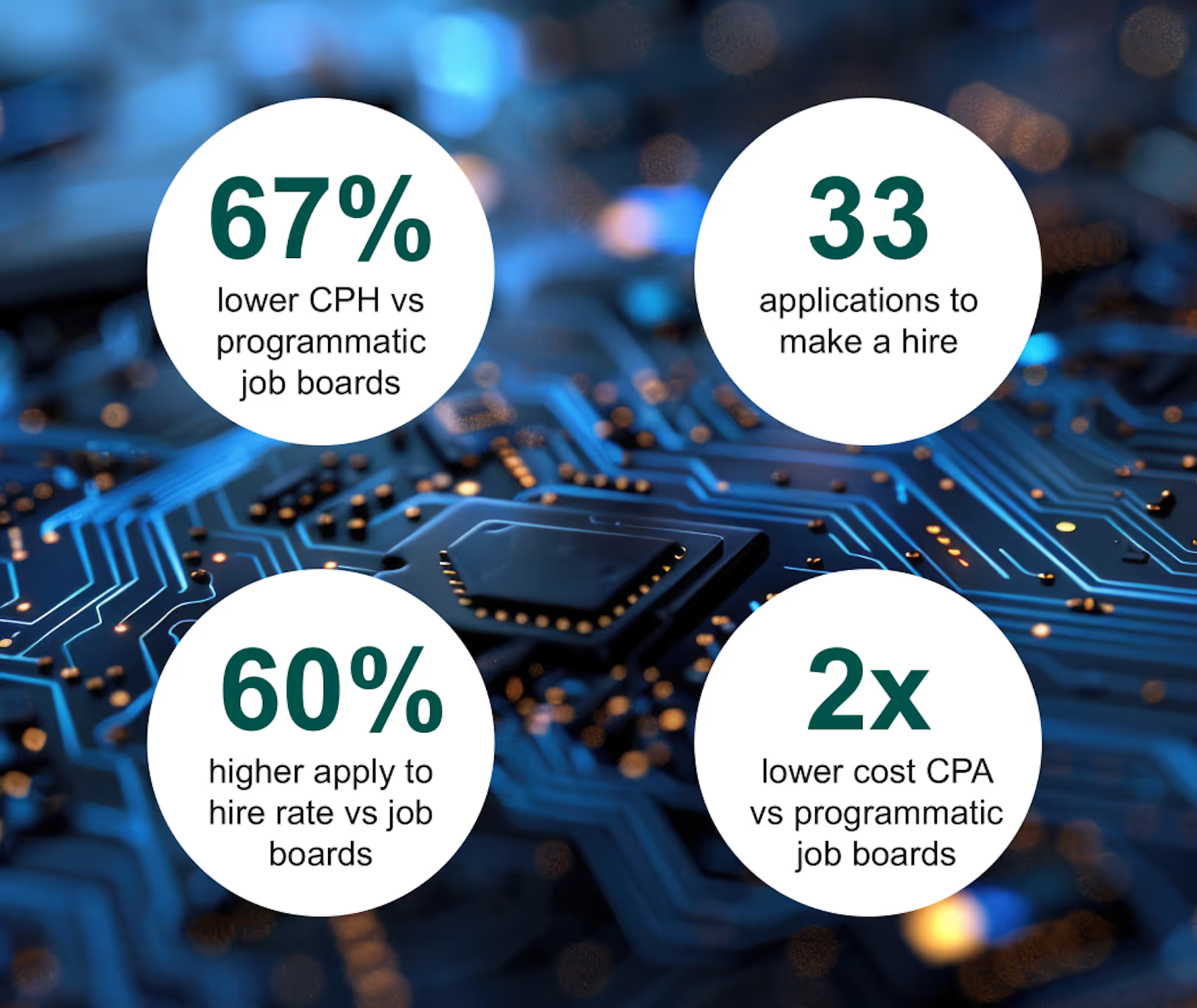
We also ran a simple reality check across the campaigns we’ve run on Gaia over the last two years. The pattern matched what customers were telling us: job boards were delivering noise, not hires.
In our internal benchmark, hiring performance on Gaia versus programmatic job boards showed:
It means job boards are increasingly the wrong starting point for growth hiring, especially when you need volume and quality at once. So many customers partner with us to help them solve the problem of what to do when job boards stop working.
A few moments from 2025 that will stick with us.
One customer called Gaia “a god-send”. Another described the relationship as “throw it over the fence”, meaning they could pass us the hiring brief and trust the system to run without weeks of back and forth, saving them huge amounts of time and money.
We also ran two webinars that made the pattern clear. Teams want to do more on social, but they do not have the time, skills, or headcount to plan creative, build campaigns, optimise daily, and report back cleanly.
If you missed them, the DHU Healthcare webinar is a good example of the questions TA leaders are asking, and what “good” looks like in social-first delivery. Sign up here: https://www.iamgaia.com/dhu-healthcare-webinar
The Babcock webinar is also available on demand here: https://www.iamgaia.com/babcock-webinar
If you watch them, you’ll learn what a high-performing social-first hiring campaign looks like end to end, including the creative that drives quality, the retargeting that brings intent back, and the metrics to track beyond clicks.
RecFest conversations were consistent too. TA leaders are tired of paying for volume that does not convert, and tired of channels that cannot show cause and effect.
If you want a clean snapshot of what performance-led recruitment marketing looks like in practice, these two case studies say it all.
Mitie hired 250+ custody staff 45% faster and cut cost per hire to £240 using Gaia’s AI-powered, cross-channel campaigns. Read the case study here: https://www.iamgaia.com/case-studies/mitie.
Babcock drove 571 hires, generated 32 million+ impressions, and delivered a £200 cost per hire, with £80,000 saved. Read the case study to find out how: https://www.iamgaia.com/case-studies/from-zero-to-millions-babcocks-social-media-hiring-revolution-with-gaia
Most teams do not need “more AI” in theory. They need AI in the parts of the workflow that drain time and budget. And that’s where we fit in.
LinkedIn’s Future of Recruiting 2025 report found 73% of talent acquisition pros agree that AI will change the way organisations hire.
At Gaia, AI drives recruitment marketing performance across social media channels in three practical places.
And conversion still matters. If your apply flow leaks candidates, you burn budget whatever the channel.
This is why candidate experience became a bigger topic in 2025. Here’s our blog post that breaks down the cost of candidate drop off, and the fix.
If you want to see the product layer behind that, GaiaPages is our mobile-first, fast apply experience. Yes…45-seconds…applying is as easy as buying something on Amazon – checkout GaiaPages here.
This is the short version. We will go deeper in the follow-up post before the end of the year.
A practical starting point for Q1 2026? Move a portion of job board spend into a social-first campaign that uses employer content and always on retargeting. Measure apply-to-hire and time-to-fill, not clicks.
If you want to see what this looks like for your roles, book a demo here.
If you need ATS and workflow connectivity, our integrations page is the best reference point.
Candidate attention shifted further to social feeds, and job boards showed more signs of strain.
Recruitment marketing on social media, powered by AI targeting, retargeting, and continuous optimisation.
Build social-first campaigns, then measure apply-to-hire and time-to-fill, not clicks.
It’s using paid social, content, and retargeting to reach candidates in-feed, then using AI optimisation to reduce waste and improve apply-to-hire.
Sometimes, especially for active jobseekers. But they are weaker as the primary channel when you need to reach passive talent and prove ROI.
Fix conversion first (mobile-first apply), then use social-first distribution with always on retargeting, and track apply-to-hire.
Who is Gaia best for
Gaia suits in-house recruitment teams, agencies and RPOs who want:
- To reach beyond job boards into the open web and social channels.
- Real-time campaign optimisation and data-driven decision making.
- Flexibility between self-serve and managed service.
- Seamless integration with existing ATS workflows.
- A measurable lift in quality and volume of applicants.
Adzuna works well for teams who want a large active-jobseeker search audience, now combined with social advertising and candidate automation, delivered as a managed service.
Final word: Gaia vs Adzuna
If you need broad, AI-targeted reach, multi-channel automation and real performance data, Gaia delivers a fundamentally different proposition to job board aggregators like Adzuna. Both now operate in social recruitment advertising, but Gaia is purpose-built for performance, with broader reach across the open web and paid search, real-time cross-channel optimisation, cookie-free retargeting and the choice of self-serve or managed delivery. For TA, HR and EB leaders tasked with hitting hiring targets in competitive markets, Gaia provides the tools, intelligence and flexibility to succeed.
Learn more about GaiaComplete or book a demo to see it in action.