
You pay for a click.
A candidate lands on your page.
They get distracted, hesitate, or hit friction.
And you never see them again.
That is not a candidate problem. It is a journey problem.
Retargeting is one way you can fix it. Not by showing the same job ad again and again, but by helping the right candidates make the second decision.
This is Post 5 in our 2026 recruitment marketing series.
Recruitment marketing retargeting is the process of re-engaging people who have already shown interest or intent, then guiding them to the next step. In 2026, it should achieve three things.
First, more completed applications from the same spend.
Second, fewer irrelevant applicants, because you focus on higher intent.
Third, faster hiring, because fewer good candidates fall out of the funnel.
If your retargeting is not moving those outcomes, it is just extra frequency.
Hiring teams are under pressure to do more with less.
At the same time, the candidate journey is harder to track cleanly.
Candidates take multiple touches. They switch devices. They browse in feeds.
So the first click is rarely the decision.
Retargeting is what stops your spend leaking after the click.
If you want the full operating system context, start with the hub article: Recruitment marketing in 2026: the operating system for hiring teams under pressure.
If you missed earlier posts in the series, these will help.
Post 1: Job boards are not a strategy in 2026. Here’s the replacement.
Post 2: AI recruitment marketing explained: what it does, what it doesn’t, and why it matters
Post 3: Recruitment marketing targeting: how to reach the right candidates without paying for noise
And if your biggest leak is the apply journey, Post 4 shows how to fix conversion first: How do you fix your apply flow in 2026? A conversion playbook for recruitment marketing.
Retargeting works when it behaves like a hiring journey, not a reminder ad.
It starts with intent. Someone who started an application is not the same as someone who skimmed a job page.
Then it matches the message to the hesitation. Most candidates pause because they are unsure it is for them, unsure it is worth it, or unsure it is easy.
Finally, it fixes the post-click step. If you send warmed-up candidates back into a clunky ATS portal, you are repeating the problem with extra frequency.
Retargeting fails when the objective is unclear.
Choose one primary objective per campaign, and keep your measurement aligned to it.
Use this when the person has high intent.
That usually means they clicked apply, started an application, or spent meaningful time on a specific role.
Your job is to remove friction and make the next step feel easy.
If your ATS is clunky, instead route candidates to a fast landing page and a short first step, then let them complete later (with timely reminders to nudge them through the candidate funnel).
Use this when the role needs persuasion.
Hard-to-fill roles, senior roles, specialist roles, or any role where the offer needs context.
Your job is to build confidence.
Show what the role is really like, what support looks like, and what happens next.
Use this when you hire continuously for similar roles and you want to reduce paid dependency over time.
Your job is to earn permission.
That might be a talent community, a role alert, or a simple “hear about new roles” opt-in.
Stop thinking in one retargeting audience. Instead, use intent tiers so your message stays relevant.
These people are closest to conversion.
They started an application, clicked apply, or reached a point where they clearly tried to progress.
Tier 1 needs a fast next step, not more persuasion.
These people showed role interest but did not commit.
They visited a job page, used location or department filters, or browsed several roles.
Tier 2 needs clarity.
Make the role feel real and remove doubts early.
These people engaged with your employer brand rather than a specific role.
They watched a video, engaged with posts, or visited your profile.
Tier 3 needs narrative.
It is about trust, not pressure.
Good retargeting creative answers the real questions behind the pause.
Is this for me?
Is it worth it?
Is it easy?
Help people self-select. There are lots of ways to do this.
For example, show what the role involves in week one or month one, what good looks like, and who it suits.
Clarity reduces drop-off and improves quality.
Make the trade-off feel fair.
Be specific on the basics candidates care about.
An actual pay range beats "competitive salary" every single time. It's what candidates want to see up-front.
Also think about shifts, travel reality, progression, training, and support.
Tell candidates what effort is required, and make it true.
Show employees "in-job", use quotes or short videos that show off your employer brand, culture and values. Authenticity builds trust.
Design the creative to show real people doing real work in the actual job to attract candidates of a similar profile. Make it relevant to them.
Provide a journey from the first ad they see through to the urgency of hiring before the deadline so they don't miss out.
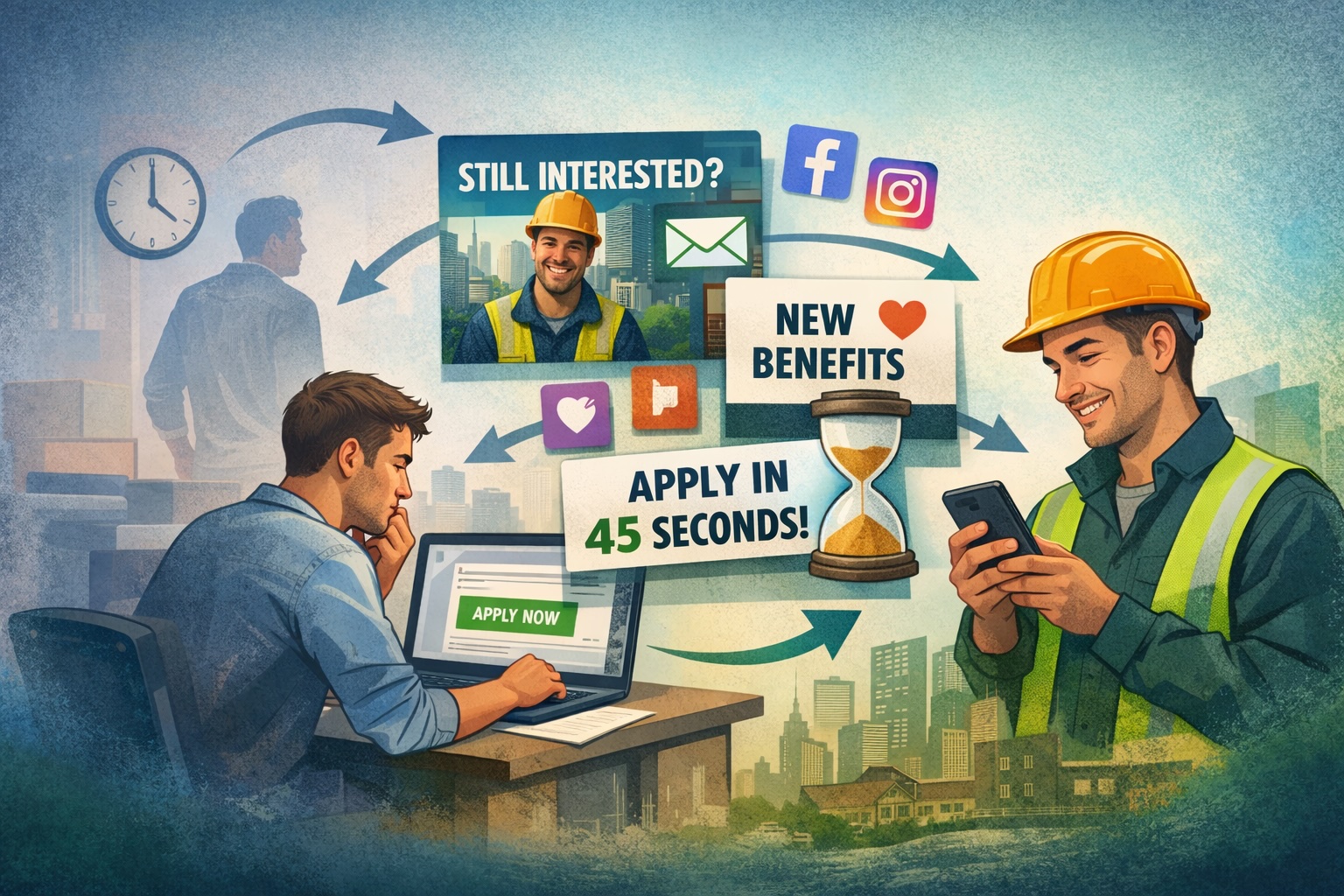
And if you can genuinely offer a short first step, lead with speed. If you are using GaiaPages, “45 seconds to apply” works because it sets expectations and reduces the mental cost of starting by removing friction. And it's all on-brand too.
In simple terms? Where your ideal candidate profiles spend their time online.
Do not treat channels as strategy - that's the first mistake for any type of marketing campaign. Channels are distribution.
You want coverage across high frequency environments and high intent environments, relative to your audience.
And there are some simple guardrails to help guide thinking...
Meta is usually the most efficient channel for repetition at scale.
Google often captures candidates who keep searching after the first visit.
YouTube is strong for trust and consideration for harder roles.
LinkedIn can work well for professional segments, as long as you watch costs and keep the journey tight.
It's more complicated than this, of course - demographics and reach and look-a-like audience behaviours all play an important part.
Retargeting traffic is not cold, and so it should not be treated like cold traffic.
Do not send warmed-up candidates to a login wall, a long form, or a slow ATS portal.
Make their journey easy to follow and to complete.
Use a short first step.
Name, email or phone, and one or two qualifying questions.
Then let them complete later with timely reminders to encourage them to complete their full application.
This is the same conversion principle from Post 4, applied to the highest intent audience: How do you fix your apply flow in 2026? A conversion playbook for recruitment marketing.
Retargeting fails when it becomes stalking. It needs to inform, add value, and continue the story for the candidates.
It’s good practice to use guardrails so you stay helpful, such as these:
Tier 1 can tolerate a higher frequency in a shorter window because intent is high.
Tier 2 needs a moderate frequency with more message variety.
Tier 3 should be lighter touch over a longer window.
Always exclude people who have already applied. If you do not exclude, you waste budget and damage trust.
You do not need a complex setup to get value.
You need one clean loop.
Start with two audiences.
Apply starters in the last 14 days.
Job visitors in the last 30 days.
Now run two messages.
For apply starters, lead with friction removal and a fast next step.
For job visitors, lead with role clarity and proof.
Then apply two rules...
1. Exclude applicants.
2. Cap frequency and refresh creative regularly.
That is enough to stop the worst spend leakage and start compounding returns.
If you measure clicks, you will optimise for clicks. Stay focused and measure outcomes.
Start with:
Then add a quality proxy so you do not optimise for volume.
If you can connect retargeting activity to downstream funnel stages, do it. That is where integrations matter.
Most retargeting underperforms for predictable reasons.
Teams treat everyone as one audience.
They send high intent people back into the same clunky journey.
They forget exclusions and waste spend on applicants who have already completed the journey.
They run the same creative for weeks. Where's the story behind the role or the employer brand?
They optimise to clicks and wonder why quality does not improve.
Avoid these, and you are already ahead.
Retargeting should not mean risk. In 2026, you need privacy-safe ways to re-engage candidates. Cookie-free targeting (and therefore re-targeting) is a must especially since Google began switching off third-party cookies in Chrome in early 2024.
Ask your vendor how retargeting works without relying on third-party cookies, what data is used, and what controls exist.
If you want the wider governance lens, Post 2 covers what to ask, and what to avoid: AI recruitment marketing explained: what it does, what it doesn’t, and why it matters.
Start with a simple audit.
Check where retargeting traffic lands.
Split your audience into Tier 1 and Tier 2.
Write two messages: role clarity and fast apply.
Add exclusions for applicants.
Review mobile completion rate and fix the biggest friction point.
Want retargeting that converts clicks into qualified candidates?
If you are paying for traffic and losing candidates after the click, GaiaComplete helps you build the full operating system. Why not book a demo and discuss how we provide audience-first targeting, fast mobile-first apply with GaiaPages, privacy-safe retargeting, and optimisation in real time.
Recruitment retargeting is re-engaging people who have shown intent, such as job visitors or apply starters, to move them to the next step. In 2026 it should focus on completed applications and quality, not impressions.
Segment by intent, cap frequency, rotate creative, and exclude applicants. Retargeting should feel helpful and relevant, not repetitive.
Start with apply starters and high-engagement job visitors. These audiences are closest to conversion and offer the biggest performance gains.
A fast, mobile-first next step. Avoid long forms and login walls. Use a short first step and let candidates complete later.
Track apply starts, completed applications, cost per completed application, and a quality proxy. Where possible, connect to downstream conversion through integrations.
Recruitment marketing retargeting works by segmenting audiences by intent, matching creative to candidate hesitation, sending people to a fast mobile-first next step, and excluding those who have already applied. The goal is more completed applications and better candidates from the same spend. Think about it: it's the same approach that consumer brands have applied with their advertising campaigns for many years - you show some kind of interest in a pair of shoes and you start seeing ads for them and other products from that brand across different social and digital channels, convincing you to make the purchase.
Who is Gaia best for
Gaia suits in-house recruitment teams, agencies and RPOs who want:
- To reach beyond job boards into the open web and social channels.
- Real-time campaign optimisation and data-driven decision making.
- Flexibility between self-serve and managed service.
- Seamless integration with existing ATS workflows.
- A measurable lift in quality and volume of applicants.
Adzuna works well for teams who want a large active-jobseeker search audience, now combined with social advertising and candidate automation, delivered as a managed service.
Final word: Gaia vs Adzuna
If you need broad, AI-targeted reach, multi-channel automation and real performance data, Gaia delivers a fundamentally different proposition to job board aggregators like Adzuna. Both now operate in social recruitment advertising, but Gaia is purpose-built for performance, with broader reach across the open web and paid search, real-time cross-channel optimisation, cookie-free retargeting and the choice of self-serve or managed delivery. For TA, HR and EB leaders tasked with hitting hiring targets in competitive markets, Gaia provides the tools, intelligence and flexibility to succeed.
Learn more about GaiaComplete or book a demo to see it in action.